Refurbishing wind turbine parts cuts up to 80% of CO₂ emissions. Here’s the proof!
-
Switching to renewable energy isn’t just smart, it’s essential. According to the International Energy Agency (IEA), renewable energy sources - particularly wind and solar - helped reduce energy-related CO₂ emissions in advanced economies by 120 million metric tons in 2024. However, while the global market moves forward to clean energy sources options as an alternative to fossil fuels to combat climate changes, the industry still faces environmental challenges, like high material requirements and difficulties managing circular supply chains.
In the wind sector, for instance, greenhouse gases are emitted in the production, installation, operation and decommissioning stages of a wind turbine life cycle. The circular economy is a widely debated method of reducing waste and resource consumption by closing material loops, keeping products and materials in continuous use. Strategies like condition-based maintenance, reuse, refurbishment, remanufacturing, and recycling of wind turbine components are emerging as key priorities in response to growing pressure for greenhouse gases reduction.
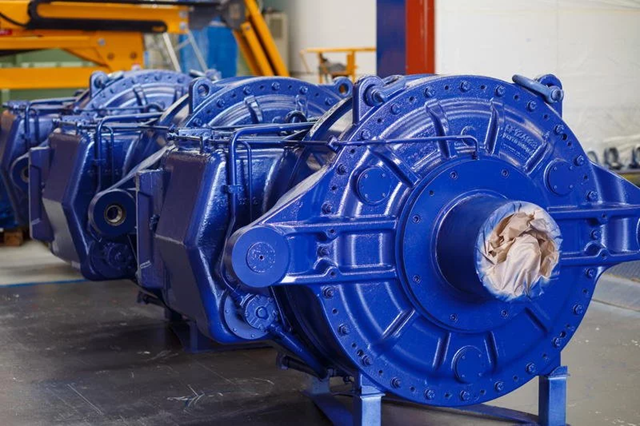
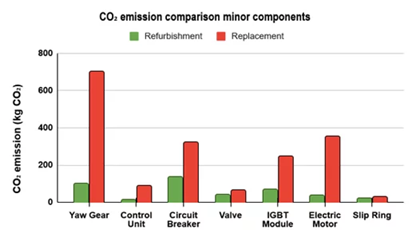
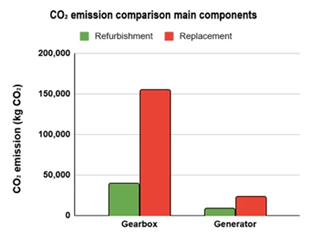
A recent study, conducted by Jerome Nyikyaa Terver (master’s student at Universidad Politécnica de Madrid), in partnership with Spares in Motion, explores the impact on CO2 emissions of a circular strategy that has been gaining significant attention: the refurbishment of wind turbine parts. The refurbishment solution extends the lifespan of components, reduces waste, and optimizes resource use. The research analyzed nine components, covering the full process - from raw material extraction and transportation to workshop energy use and parts replacement: Yaw gears, Gearboxes, Generators, Main Circuit Breakers, Control units (PCBs), IGBT modules, Valves, Electric motors, and Slip rings. Refurbishment emissions were calculated and compared to replacement emission to quantify the CO₂ emissions savings.
The graphics below show CO₂ emissions comparison between both processes.
One of the main obstacles for owners and operators to incorporate refurbishments into their processes is the fact that most ERP systems used in the industry cannot fully track all the material flows of circular supply chains.
To address this problem, Spares in Motion developed its own internal web application to completely monitor the refurbishment process of all the components we manage. The CO2 savings estimation is being included in the Refurbishment Portal and access given to our customers to track the components in the process, follow their emissions performance, and assess their contribution to sustainable targets.